onQ uses startup dependencies when a group of RNs is started on the HA or a group, or all, RNs are started on the DR Appliance or DR Mirror. For more information, go to Start recovery nodes on HA Appliance and Start recovery nodes on DR Appliance or DR Mirror. 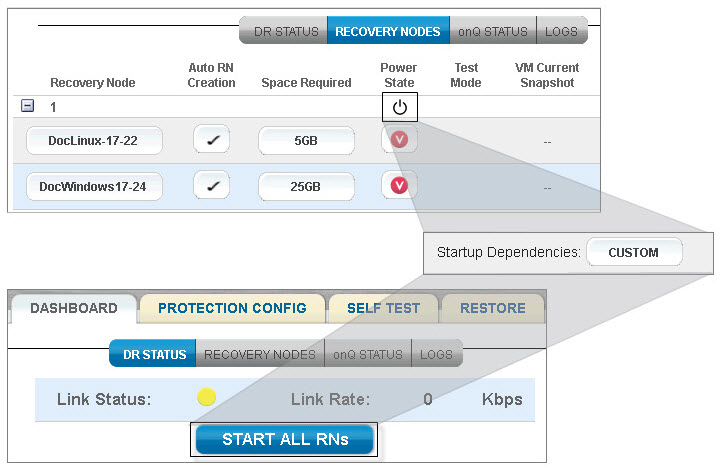
|
1.
|
Log on to the HA Appliance’s onQ Portal.
|
|
2.
|
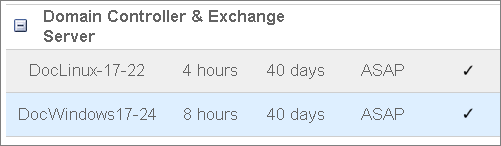
Create a group to contain each dependency. For example, create a Domain Controller & Mail Server group and assign both the Exchange Server and the Domain Controller to that group.
|
|
a.
|
Click the PROTECTION CONFIG tab.
|
|
b.
|
Select the node, then MODIFY button.
|
|
c.
|
|
a.
|
Click the PROTECTION CONFIG tab.
|
|
b.
|
|
c.
|
In the Startup Dependencies field, click the NONE button. If this isn’t your first time setting up a dependency, the CUSTOM button appears instead.
|
|
d.
|
Click the plus button (+). A default entry appears in the Startup Dependencies List.
|
|
e.
|
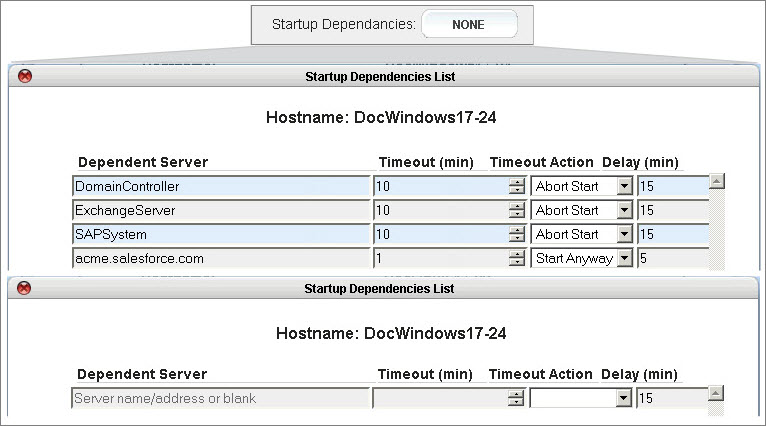
Define the Dependent Server. In the Dependent Server field, select the RN from the drop‑down list or specify the IP address or hostname of the server that is not protected by (external to) this HA Appliance and on which the RN depends. If the dependent server is an external server, you must define it in the hosts file, unless you specify the IP address. Leave this field blank to specify a delay policy instead of a server dependency (see “Delay” in Step f).
|
Timeout - Indicate how long you want the onQ to wait for the Dependent Server to respond to a ping request. The default value is 5 minutes, but base the value on the typical boot time for your server. Ensure that the firewall allows ping requests. If you specify a Dependent Server, you must also specify a timeout value.
Timeout Action - Indicate what you want onQ to do with the RN if the Dependent Server does not respond to the ping command within the timeout period. onQ can start the RN (Start Anyway) without honoring the dependent server, or you can instruct onQ to refrain from starting the RN (Abort Start), regardless of whether all other dependencies are met, because the dependent server is critical to the RN’s availability.
Delay - Specify a delay policy along with or instead of a server dependency.
- Delay policy in addition to a server dependency. Indicate how long you want onQ to delay the RN startup after onQ detects that the dependent server is up. The default value is 1 minute, but base the value that you specify on the typical time needed for your dependent server’s applications to respond to user requests.
- Delay policy instead of a server dependency. If a dependent RN is not configured to respond to the ping command on which Timeout depends, or you know that a dependent server will take a long time to boot, do not specify a server dependency; instead, create a delay policy: leave the Dependent Server field blank and specify a Delay time that accounts for the typical time needed for your dependent server’s applications to respond to user requests. In this case, the delay option ignores values for Timeout Action and Timeout. You can only specify one such delay policy; if you try to specify two policies, the onQ Portal returns an error: Only one row may have a blank server entry for a delay only specification.
|
4.
|
Click SAVE.
|
|
•
|
To clear all data and start over, click CLEAR. Default values repopulate the fields provided.
|